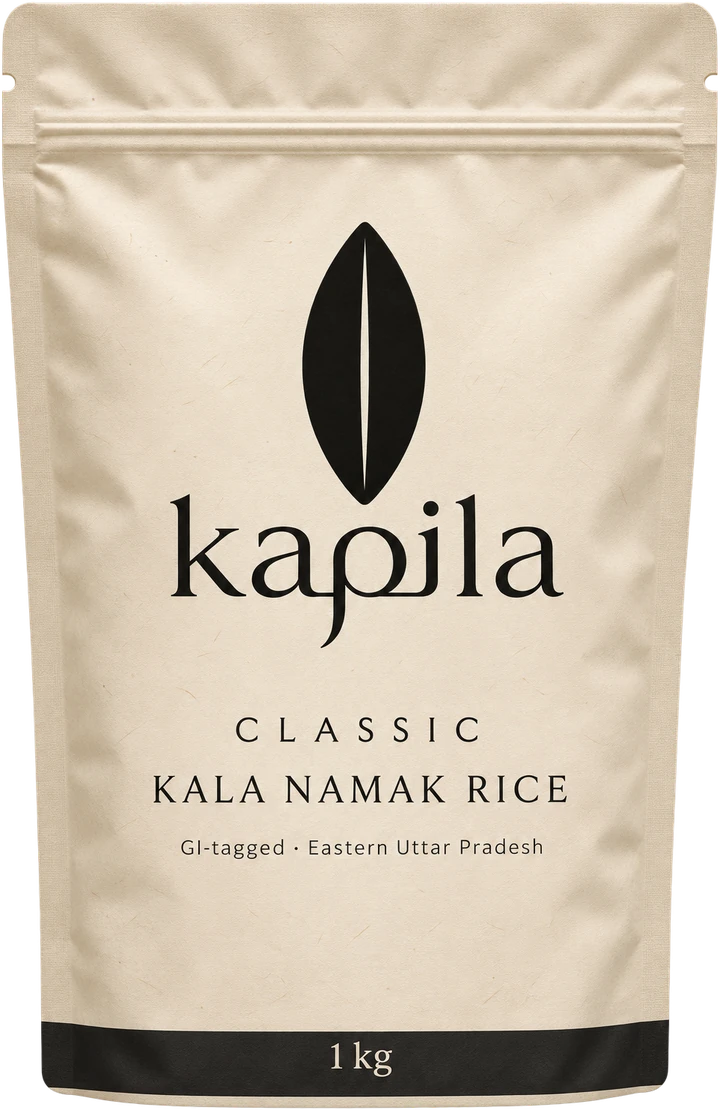
Kapila Kala Namak rice in five variants: Classic, Royal, Brown, Organic and Instant
Five waysto eat it
Same grain from the same eleven districts. Polished, hand-sorted, unpolished, organic or precooked. Pick the one that fits your kitchen.
Variant concepts for a student project. No prices yet. Organic would need certification before launch.
Three dishesto start with
Kala Namak cooks softer than basmati, so start with a little less water. Quantities are a starting point.
Build your3 packtrial box
Not sure which variant suits you? Pick any three and we'll send small sample packs so you can cook them side by side.
Know thegrain
Every number here links to where it came from.
Protected by a GI tag
Only rice grown in the designated districts of eastern Uttar Pradesh can be sold as Kala Namak.
Source: Wikipedia
Districts, one belt
Siddharthnagar and ten neighbouring Terai districts across the Gorakhpur, Basti and Devipatan divisions.
Source: IRRI
Grains grow when cooked
Kala Namak elongates more than basmati (1.8 to 2.0 times) on cooking.
Source: Down To Earth
Amylose keeps it soft
Lower amylose than basmati (24% or more) gives a softer, fluffier cooked grain.
Source: Wikipedia
Back from the edge
Under 0.5% of Siddharthnagar's rice area in 2002; about 18,000 hectares in the district by 2025.
Sources: Siddharthnagar district, Millennium Post
Notified varieties
KN3, Bauna Kalanamak 101 and 102, Kalanamak Kiran, Pusa Narendra Kalanamak 1 and Pusa CRD Kalanamak 2 are farm varieties. Classic, Royal and the rest are our product variants.
Source: Journal of AgriSearch; PIB
From the same grain, later
Questions
Is Kala Namak a type of basmati?
Why "black salt" if the rice is white?
What is the difference between the variants?
Is it good for people with diabetes?
Can I buy it today?
Requesta sample
Tell us where you are and which variants interest you. Anything you added from the range or the trial box shows up here.